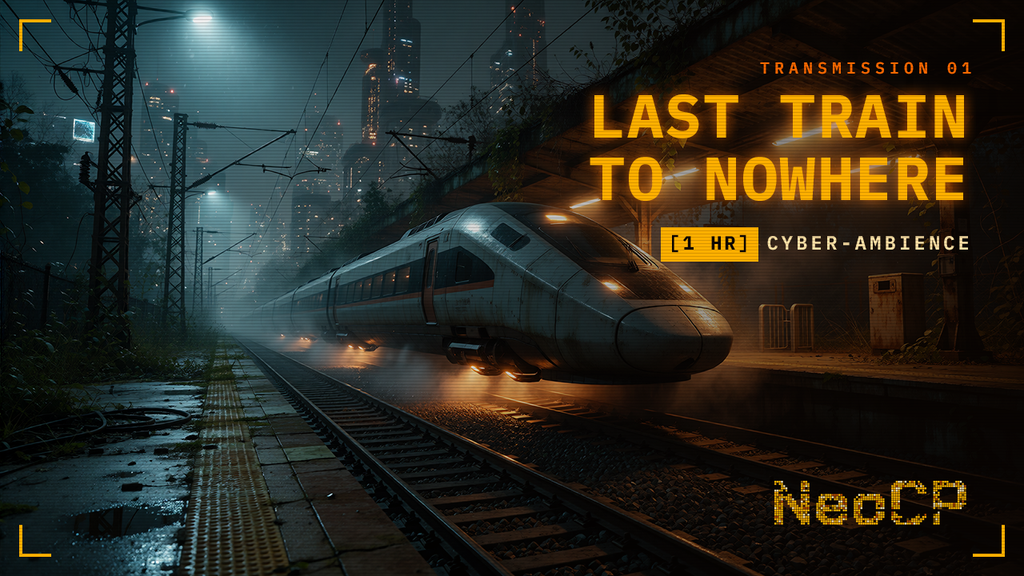
Chapter One: Last Train To Nowhere
I remember a box. It was a small case with a device inside, like a Pelican case. Black ribbed plastic, scuffed white at the corners, the kind of thing a photographer keeps a good lens in. That case is the last solid thing I can find in my memory, and I keep going back to it the way your tongue keeps finding a chipped tooth.
Now I’m standing on a platform I’ve never seen before, looking at a train that shouldn’t exist.
It hangs over the rails. There’s maybe a foot of open air between its belly and the steel, and underneath it a row of amber lights glows like coals in a grate. The nose is long and rounded and dull white, streaked with grime, as if somebody built a bullet and then left it out in the rain for ten years. A thin orange stripe runs the length of the cars until they disappear into the fog.
The vapor around it doesn’t move. That was the first thing I noticed, and it’s the thing I can’t stop staring at. Steam hang motionless out away from under the carriages in thick little clouds, and every cloud is stuck in place. I walked up and put my hand through one. Nothing. No warmth, no damp, no drift. It just sat there holding the orange light inside it like glass.
There are particles in the air too. Dust, or ash, or something finer than either. They don’t fall. They hang at eye level and turn very slowly, catching the light from the tubes under the platform canopy. The canopy is rusted through in places and vines have taken over the girders, hanging down in loops and long green ropes. A sign dangles from two chains over the platform, but the letters have faded past reading. Down at the far end a metal cabinet sits bleeding rust onto the concrete beside a pair of little swing gates that don’t lead anywhere.
Past the power pylons and the sagging wires, a city climbs out of the fog. Towers, more floors than I can count, windows lit in tidy grids. Near the top of one, a woman made of light, forty stories tall, is turning her head toward me. She stopped halfway. Under her chin, in cyan letters as big as houses, it says VANTIR. YOUR FUTURE, MANAGED. There are cars up there between the buildings, no wheels, red taillights, frozen in the air like flies in amber.
Some things do move, though.
Drones drift over the tracks, high up, sweeping searchlights across the gravel and the yellow bumps at the platform’s edge. They’re the only things in the sky that move. And there are shadows on the ground. Long, thin shapes that slide across the wet tiles with nothing there to cast them. One passed over my shoes a minute ago and the cold came up through the soles and settled in my ankles. I haven’t moved my feet since.
I keep telling myself I don’t know how I got here. That’s a lie. I know exactly how I got here. I just don’t understand it.
I was on the Empire Builder, eastbound out of Spokane, heading to Libby. A widow there had written me about a box of Forest Service survey sheets from the 1920s that had belonged to her husband, hand inked, Cabinet Mountains and the Kootenai drainage. Most people collect stamps. I collect maps. My hallway in Seattle has an 1891 USGS quadrangle framed on it that cost me more than my first car, and I’d been looking forward to this trip for a month.
The Kootenai was sliding by outside the window, green and fast. The seat next to me was empty. I know it was empty because I’d put my jacket on it. Then I looked up from my phone and there was a man sitting there, and my jacket was folded neatly in his lap.
He was old. Seventies, maybe more, with a gray wool coat and hands spotted like a trout’s back. I hadn’t heard him come down the aisle. I hadn’t felt the seat shift.
“You’re the engineer,” he said. “The one who teaches machines to think.”
I build language models for a company in South Lake Union. It’s not a secret, but it’s not something you’d know by looking at me either. I asked him if we’d met.
“No,” he said. “But I know you like maps. The 1891 quadrangle. Good choice. They got the ridgelines wrong west of the river, but nobody’s perfect.”
I should have gotten up. I know that now. Instead I asked him what he wanted, and he lifted the case onto his knees, the black one, and turned it toward me and popped the latches.
Inside was a panel of brushed aluminum set into gray foam. There were knobs with knurled edges, a row of toggle switches, a few square buttons, and three little LED displays glowing in colors that didn’t seem quite right. One was a green that leaned almost blue. The characters on them flickered in and out and never settled into anything I could read.
“Go on,” he said. “Turn that one.”
I turned it. Nothing happened. He pointed to another, and I turned that too, and pressed a button he tapped with one fingernail. The displays flickered a little. That was all. He nodded like I’d done something important.
“It listens first,” he said. “Then it talks.”
Then he stood up, set my jacket back on the seat, and said his bladder was older than he was and he’d be right back. He went down the aisle toward the restroom at the end of the car. I watched him go, and then I looked down and saw the case still sitting open on the seat beside me.
I turned to call after him. The aisle was empty. The restroom door said VACANT. I got up and checked the vestibule between the cars, and there was nobody there but a conductor who said she hadn’t seen any old man in a gray coat.
I sat with the case for twenty minutes. I told myself I’d turn it in at Libby. I told myself a lot of things.
Then I opened it again.
The displays were different now. They’d settled. Two of them were showing numbers, plain ones, and it took me a second to see what they were because I wasn’t expecting them. 48.388 on one. Negative 115.556 on the other. Latitude and longitude. I didn’t have to look it up. Anybody who has stared at the map of northwest Montana as long as I have would know it. Those were the coordinates for Libby.
The third display was counting down from nine.
I should have closed the lid. I put my hand on the last knob instead, the big one in the middle, and gave it a quarter turn, and pressed the red button under it.
The case hummed. I felt it in my teeth before I heard it. All three displays went white at once, and the light spilled out of the foam and up into my eyes, and the car started to smear like watercolor left in the rain. The woman knitting across the aisle thinned out to nothing. The kid with the tablet two rows up went next, then the conductor, then the window and the river behind it.
And then I was here, on this platform, with my hand still out like I was holding something.
A drone swings its light across the platform and the beam passes over the dangling sign. For a second the light catches it at the right angle and I can see the letters pressed into the metal, under the rust.
LIBBY.
Impossible! Libby’s a little town and there’s not a big city for miles near it.
Below that, smaller, stamped in a clean corporate font: VANTIR TRANSIT AUTHORITY. ZONE 48.
I’m still reading it when I hear the hiss.
The vapor moves. All of it at once, rolling out across the gravel and up over the platform edge, warm and wet against my face. The particles fall like snow. Up in the fog the giant woman finishes turning her head, and the cars between the towers slide away down their invisible lanes, and the shadows on the ground pull back toward the dark like water going down a drain.
The nearest door of the train slides open.
There’s an old man inside just inside the door, in a gray wool coat, with a black case resting by his side.
“There you are,” he says. “I was starting to think you’d never turn the big one.”
The man dropped the case beside the tracks. The train disappeared.